Abstract – Though prior statistical studies, now confirm the lines in ancient geometric patterns were deliberately aligned to represent astronomical values, the proposed secondary meaning behind these ancient lines (this being the observed four-fold symmetry is linked to an archaic alphabet, where the angle represents the consonant and the direction of the line the vowel) still requires further study.
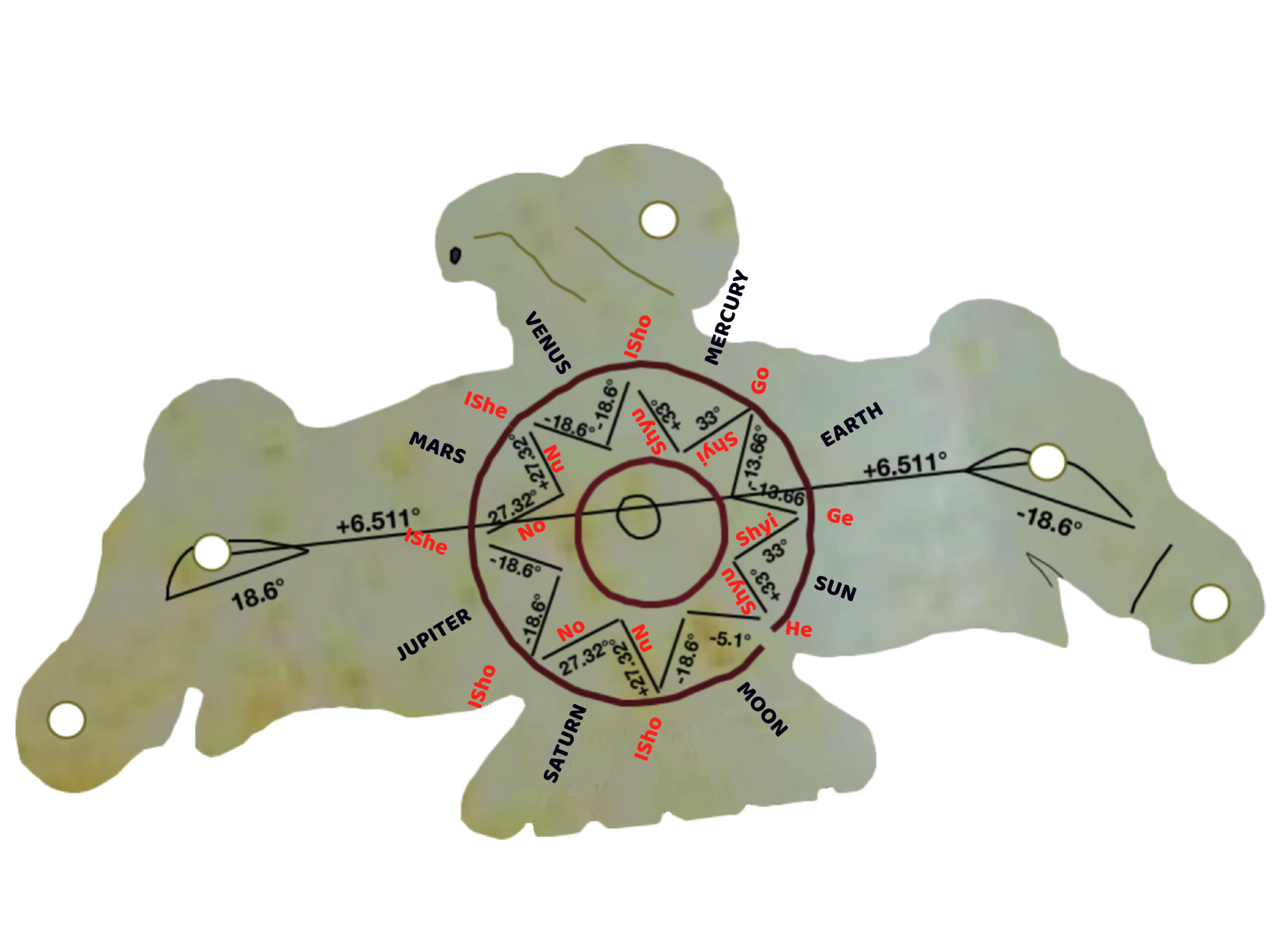
Prior to publishing this study, only one study has allowed the extraction of the potential phonetic code behind these lines. This study involved the analysis of the eight-pointed star, and the diameter of the circles carved on the Lingjiatan Jade Eagle pendant. This identified that the angles used in creating the eight-pointed star were symmetric, and it was noted the circles on pendant appear to be consistent with the orbits of the visible planets. After preliminary phonetic values were assigned to specific angles, the phonetic values were compared to the known phonetic values in Irish Ogham (which also employed a series of parallel linesto create a written text). From this, an overlap was observed in the phonetic values. In this study, the aim is to now analyse the reverse side of the Lingjiatan Jade Eagle.
Introduction
in earlier studies that reviewed the angles present in archaic geometric patterns1-6, it was noted that the astronomical values used to create the Babel Text6 were able to explain many additional mysteries.
For example, the astronomical values present in this ancient text have been successfully used to explain the latitude and longitude of many the world’s oldest sites1; and the values behind these lines explained both the need for, and the dates given for the recent reset of the Mayan Calendar, which last occurred on the 21st December in the year 20121, and will next occur around the year 27,700. This small set of astronomical values and their links to the night sky also explain the Greek myths that surround the constellations, and they can even be used to explain why the Greek myths say the constellation Cancer the Crab bit Hercules’ toe and was then kicked far away from Hercules to it’s current location in the night sky1,2. These lines, and their related astronomical values, also help explain the Norse story surrounding Ragnarok1; and the same astronomical values can even be used to explain the layout of the Great Pyramids1,2.
However, despite publishing a recent statistical study, which confirmed the angles generated by these lines are not random and despite careful studies showing that a small group of astronomical values could be used to explain so many apparently unrelated ancient mysteries, the theory still remains controversial and is being ignored as a potential explanation for why geometric patterns existed in far greater numbers than images of animals and people in the early Stone Age period.
from these prior studies, the Lingjiatan Jade starburst diagram is considered the most important discovery, but it also the most controversial due to its use in extracting phonetic values.
Worldwide there are many similar images, and amongst this class of archaeological finds the closest comparable in terms of significance is the starburst image on the famous Babylonian World Map.
In the author’s earlier studies on the structure of the Babylonian World Map, it was noted that the surviving portion of the eight pointed star and the geometric patterns at the centre of the starburst image all employ lines that are aligned to astronomical values, with the angular values being consistent with those present on the Chinese Lingjiatan Jade Eagle.
The problem is, even though it had been argued by the author that the Babel Text was used worldwide1-3, and it was used unchanged for hundreds of thousands of years1-3, it was considered to be almost impossible task to construct a simple statistical study that could confirm the intent behind the lines that can be clearly seen on the two sides of the Lingjiatan Jade Eagle4.
Ultimately this problem was solved and now in this study the aim is to now review the lines one the reverse side of the Lingjiatan Jade Eagle.
In the images provided below, the structural similarities between the Lingjiatan Jade Eagle and the more famous Babylonian World map can be clearly seen in the angles drawn by the lines.

Fig. 1a. The Lingjiatan Jade Eagle Pendant shows triangular marks between two circles. In this image, which shows the Front Side of the Jade Eagle, the phonetic values attached to the various lines are based on the earliest known names for various celestial objects. The order of the objects is also the only order that appears consistent with the Earth, moon and sun being considered separate and different from the wandering stars. In more detail, any attempt to ascribe one of the 33/33 degree pairs to Earth and the other angle-pairs to the sun would require the intervening -13.66/-13.66 pair to be ascribed to the moon, which would then force one of the planets to take the -18.6/-5.1 pair. This would be inconsistent with the structure of the angle-pairs used for the other planets. The names displayed thus appears to be the most consistent, and the assignment of celestial objects to each angle-paur is also consistent with the Jade Eagle representing the orbits of the planets. See The Babel Texts, by Derek Cunningham, and the author’s prior paper in this series6.


Fig. 1b. in the authors 3D model of the Babylonian World Map, though the World Map is damaged and incomplete, the location of the three remaining “triangles” is consistent with the double circle being surrounded by an 8-pointed star. In contrast, the Lingjiatan Jade Eagle shows eight triangles placed between the two circles. The reason why the Babylonian eight-pointed star is often called a world map is the texts on this tablet describes various regions around the world. The angles drawn by triangles present in the Babylonian World Map are shown in Figure. 1c.

Fig. 1c. Image showing the angles present on the Babylonian World Map (the lines at 13.66, and 27.32 degrees represent the sidereal month3, and the lines at 9.3 and 18.6 degrees represent the 18.6 year lunar cycle). As can be seen the tablet is damaged and it is possible that the central star was surrounded by various blocks of text.
With the angles of the lines now known to be critical for measuring time, this makes it reasonable to argue that the Lingjiatan pendant might be a description of the night sky; and in the author’s prior studies1-5 it was indeed noted that the pendant can describe the orbits of the planets, as shown in the video below.
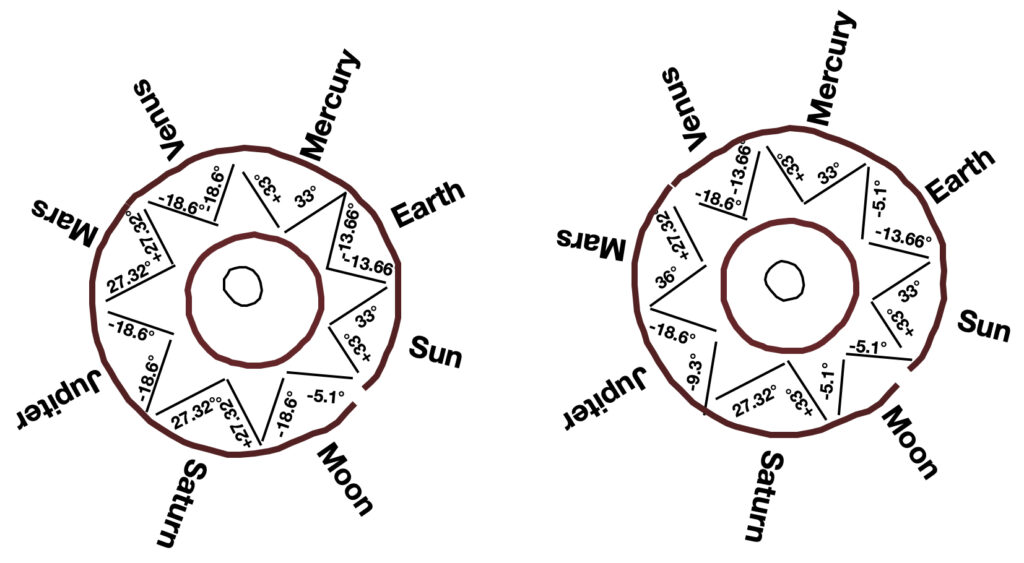
Fig. 3, the angles present on the two sides of the pendant. The “front” side is the image on the left.
Thus the 8 triangles on the front side of the Lingjiatan Pendant could represent the names of the five visible planets, and the Earth, moon and sun.
However, until now, no studies have been undertaken on the lines present on the reverse side of the pendant.
It should be noted that by rotating the object 180 degrees, if the lines were randomly placed, the angles present on the reverse side should not match the proposed Babel Texts, nor should they be consistent with the lines on the front side of the pendant; but, as can be seen, an overlap does exist
In Fig. 3 the names of the planets are transcribed in the same order on both sides. As can be seen, only the lines that are considered to represent the sun and Mercury do not change.
One possible reason for this is the sun and the Mercury appear with constant light intensity, but this would not explain the change in the pairing ascribed to Earth.
It is also possible that the line-pair currently assigned to Earth might be another celestial object, such as comets, meteors, the Milky Way, or the heavens.
A Statistical Study
If it is assumed that the error in reading the angles present on the Jade Eagle is large, in the order of ±0.5 degree, this permits a 45 degree block of space can be divided into 22 regions. with the maximum angle permitted being 44.5 degrees and ( for statistical simplicity) it is assumed that there are no lines at 45 degrees. This again is based on each line exhibiting four-fold symmetry, which permits the same angular values to appear above and below the horizontal and to the left and right of vertical.
In this manner the four directions then permit four vowel sounds to be attached to each consonant, with the phonetic value of the consonant then linked to the angle of the line.
In modern languages this is similar to Japanese, where the Katakana and Hiragana alphabets link a consonant directly to a vowel.
As noted earlier, by rotating the Jade Eagle 180 degrees to view the reverse side it is found that there are two identical line pairs. the statistical probability for four lines to appear in the same order and to be connected is related to the number of possible angles that can be read with an average accuracy of circa ±1.0 degree.
In combination theory there are 22C1 chance for a line to align to any one specific 45-degree block. However, in this case the specific orientation of the line is fixed. Thus the chance for just one line to align to the same angle is 88C1, which is equal to 1 in 88 chance.
However, this argument is for only one line. In this case, within the two line-pairs that have been argued (from prior studies) to represent the Sun and planet Mercury, there are four independent lines, which in statistical studies need to be analysed as if they are independent probabilities.
Thus it can be calculated that there is only a 1 in 59,969,536 chance for these four specific lines to overlap by chance. This already appears significant, and clearly suggests intent.
In statistics, values below .01 are usually described as being statistically significant.
It is also observed that in total there are 10 lines that match, when the pendant is rotated by 180 degreees.
The probability for this occurring by chance is only 1 in 2.875 x 10¹⁹.
This argues the chance for these lines being random is now vanishingly small, and the lines were intentionally aligned to these specific astronomical angles.
Note: from the prior statistical study the chance for the lines to be random and it is only through luck that they align to these specific astronomical values, when combined with the data from this Jade Eagle, is 1 in 8.5 x 1sup>91. This is well beyond the six sigma 1 in one billion level of certainty that was required to argue the proof of the existence of the Higgs Boson in High Energy Physics Experiments.
The only problem is the structure of the Babel Text on the reverse side of the Jade Eagle does show some subtle differences.
If we assume the translation offered for the front side of the Jade Eagle (in which the eagle head is looking to the left) is accurate, and the front side does provide the names of the visible celestial objects (with one pair perhaps being the word for Earth or another celestial object) then the same order for the planets can perhaps be used on the reverse side of the Jade Eagle.
In this case the line-pair for Mercury and the Sun remain the same, as mentioned earlier, but the pair that was originally assigned to Earth switches from [-13.66(b), -13.66(r)] to [-13.66(b), -5.1(r)]. In addition, the line-pairs for the planets (Venus, Mars Jupiter and Saturn) also show a change which each line-pair showing a change in the angle of just one of the lines.

Table 1. In this table the angles for the sun and Mercury remain constant. It is unclear if the -13.66/-13.66 pair does represent Earth, or it if represents another celestial object, such as the Milky Way, or perhaps the heavens. In this table the letters a, b, l, and r refer to the alignment of the lines to above or below the horizontal, or to the left or right of vertical.
These “half-changes” in the observed angle appear to suggest the two sides are related, but the lack of consistency in the replacement angles makes it difficult to know what the link might be.
At this point further examples of the text need to be recovered, but one possible explanation is the second side might be linked to the waxing and waning of the moon and the planets.
In the case of planets, the Sun and Mars will form their ‘waxing angle’ between conjunction and opposition, while the waning angle between the Sun and Mars will appear from their opposition to the their next conjunction. In the case of the moon, one simple way to tell if the moon is in its waxing or waning phase is see which side of the moon the shadow is on.
If the shadow is on the right side, then the moon is in its waning phase.
The advantage that this explanation has it is still linked to the planets, and only “half” of the story is changing.
another possibility is the difference in the structure of the line-pair might be linked to the duration that the planets spend above and below the ecliptic plane.
As can be seen, the problem is there is just not enough information from just one example from the Lingjiatan region, to know for certain which explanation is most relevant.
What is certain is the 8-pointed star was used worldwide, and it is only in more modern texts that it is assumed that the 8-points must represent only the sun.
Intriguingly, in Plato’s books on cosmology he did describe a two-sphere model and said there were eight circles or spheres carrying the seven planets and the fixed stars.
Here there are two circles and eight structures that can be described as triangles.
It is also worth noting that in China there are the 8 triagrams, which are collectively called Bagua (八卦). However, these modern triagrams are not based on any truly ancient knowledge.
In the 3,000 year old i-ching, the 8 trigrams are said to be based upon an earlier angular and astronomical version, and they were then converted to the series of parallel solid and broken lines that we know today, with the four-fold symmetry reduced to just a mirror plain.
The eight Chinese hexagrams are thus now linked to the elements and the entire heavens are compressed into just one of the triagrams. The 8 triagrams are as follows
- ☰ Ch’ien or Qian (The Creative), Strength, Image – Heaven 乾
- ☷ K’un (The Receptive) Devoted, Image – Earth 坤
- ☳ Chen or Zhen (Motion, transition), Image – Thunder 震
- ☵ K’an or Kan (Danger), Image – Water 坎
- ☶ Ken or Geb (Rest or immobility), Image – Mountain 艮
- ☴ Sun or Xun (Penetration), Image – Wind/Air 巽
- ☲ Li (Light Giving), Image – Fire 離
- ☱ Tui or Dui (Joy), Image – Lake 兌

For completeness, the legends surrounding the 8 trigram symbols are they were created over 3,000 years ago by a legendary figure called Fu Hsi, and were an improvement upon earlier systems that were then in place. The older system was ascribed to an ancient map that was created by “The River” (The Milky Way) and the map was borne by a horse. In modern texts this is simplified to a rigid square box in which there is a grid of dots.

The square dot-map of the world may appear strange, but tis link to ancient astronomy was discussed in my book The Map that Talked, which converted the Earth into an Equirectangular Mercator map.
In the Chinese modified system it is created using a series of dots that are grouped together with each group exhibiting a different number. The mentioned River that is linked to this map is sometimes considered to be The Milky Way
Here it is possible that the dots are stars, or constellations, with perhaps the number of the dots in each group representing the number of stars in a constellation.
Unfortunately, though Confucious stated, circa BC 1079, that this “map”, and many other curiosities were still preserved in the royal court, with the passage of time these ancient documents were lost and the original texts no longer survive.
Discussion and Conclusions
Within Chinese text books there are other surviving examples of Jade Eagle with sunburst symbol, but clear images of these Eagles are seldom published. These images are often described as being early examples of the Phoenix.
However, despite this problem, the replication here of the angles on both sides of this Jade Eagle does confirms the lines are aligned to astronomical values. This argues this specific pendant contains some of the earliest surviving Chinese examples of the Babel Text.
References
- The Map That Talked, CreateSpace Independent Publishing Platform, first published Nov 2012, current edition published 2018.
- The Babel Texts, CreateSpace Independent Publishing, 2018
- Derek Cunningham, New Study Reveals Stone Age People Could Read – and were Homo sapiens the first species to learn to write?, Babel Texts Research Letters, February 25, 2024.
- The Oldest Names of the Planets: The Lingjiatan Jade Eagle, Babel Text Research Letters, March 9, 2024.
- Derek Cunningham, Use Of The Babel Text At The SanXingDui Site In China, Babel Text Research Letters Feb 25 2024.
- Derek Cunningham, Stonehenge And The Orbits Of The Planets. Do The Ancient Wood Posts Surrounding Stonehenge Mark The Planets Orbits? Babel Text Research Letters Feb 25 2024.
- the image on the second side is found in the publication by J.G. Cheock, see Austronesian Myth or History https://www.google.com/books/edition/Austronesian_Myth_or_History/JlukEAAAQBAJ?hl=en&gbpv=1&dq=jade+eagle+Lingjiatan&pg=PA18&printsec=frontcover).
- The Sacred Books of the East: The I Ching edited by Friedrich Max Müller, page 6, King Wan dated to 1143