

Abstract – In this short study preliminary data from the walls at Sacsayhuamán is compared with the layout of Sacsayhuamán. The data shows that both the walls and the angles created by the stones that are used to create the walls are aligned to the same angles and to the same group of astronomical values.
Introduction
At various sites the same astronomical values have been found in geometrical images. Recently, the proof that these lines are aligned to astronomy, with the majority linked to the study of the moonrise and moonset over its 18.6 year Lunar Standstill was first published in the author’s book, The Babel Texts, and more recently in a recent research article. This confirmation used a simple comparison of data taken from archaeological sites worldwide with the then standard theory being the angles present in the world’s oldest geometric patterns should be random if they were artistic doodles. This study included a preliminary study of the angles created by the geometric stones in the walls at Sacsayhuamán in Peru, and The Temple of Apollo and Athena at Delphi in Greece.
However, in the prior studies, due to most photographs of Sacsayhuamán being taken too close to the wall, or at angles where the camera was not perpendicular to the wall, it was difficult to undertake an accurately study this wall. Thus the analysis was preliminary, and the primary data for concluding that geometric stones are linked to astronomy was based on a small sample size and the author’s related study of the polygonal walls at Delphi, which involved taking photographs systematically along the length of the wall every two to three feet, and then removing any regions where camera lens distortion may have caused the lines to change in angle.
In this study the data from Delphi is now compared to a more detailed review of walls at. Sacsayhuamán.
Results
Through employing satellite images, where the image has been corrected for distortion and found to generate identical data to LIDAR and 3D reconstructions, it is now possible to obtain a reasonably accurate overview of the layout of the walls at Saksaywaman.
in this drawing, the layout of the walls and the angles that the walls are aligned to are shown.


As can be seen the most common angles seen are generated from walls aligned to 9.3, 13.66 27.32 and 1 degrees, with the walls aligned to 18.5 degrees appearing 5 times. This compares well with data taken from all large-scale geometric patterns.
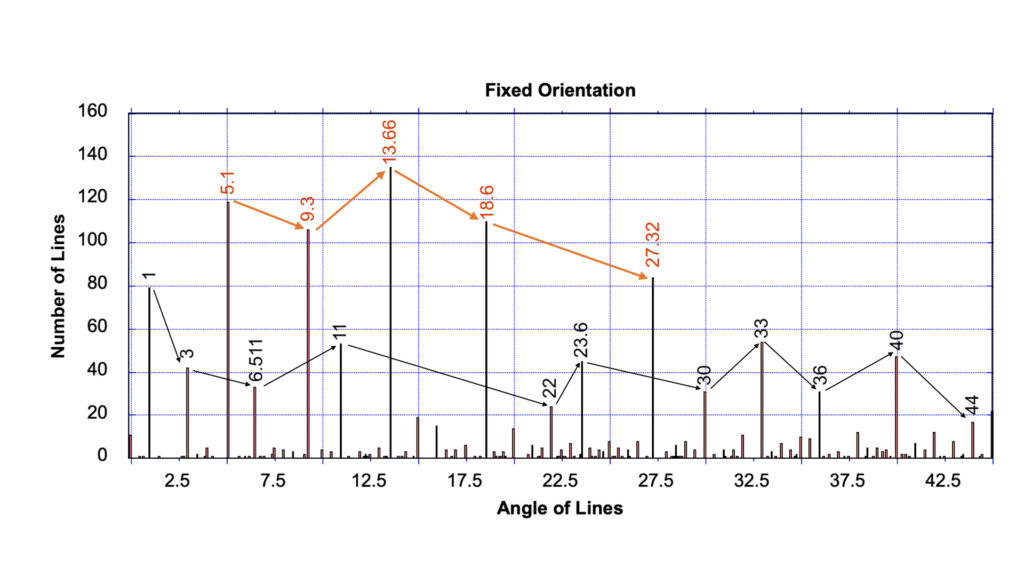
In the second graph the data is from a study that includes the angles present in the polygonal walls at Delphi in Greece, the layout of the secondary circles at Stonehenge, and the geometrics found at Lascaux Cave in France.
Looking now at the individual stones that make up the wall of Sacsayhuamán, though not every stone has been studied, where data has been obtained the results are consistent with the proposed Babel Text.
This can be seen in the reconstruction of two stone panels, which were taken from several individual photographs to cancel the effect of camera lens distortions.


Drawings of two sections of wall panels at Sacsayhuamán. Data taken from multiple images to correct for less distortion.

Graph of the distribution of angles within four wall panels at Sacsayhuamán.
The data presented here, though gathered from only four of the Sacsayhuamán panels, already shows peaks in the angular distribution at 1, 3, 5, 9.3, 13.66 and 27.32 degrees, with the sidereal month and lunar standstill values accounting for 40 of the 101 lines studied.
Here the relatively high percentage of lines at 1 and 3 degrees is noteworthy, and these values are consistent with the need to reset the lunar and solar years once every three years, but what is most noteworthy is the lines at circa 6.5 degrees are set closer to 6.83 degrees, this being the quarter sidereal month.
As mentioned, for one quarter of the month the moon sets each night further north, then for 13.66 days (the half sidereal month) the moon gradually sets further south, before turning north again for one quarter month. Thus, further studies are required to determine the accuracy of these stone walls and the actual angle that these walls create.
Conclusions
Though data collection is still incomplete, from the data that has been collected it is already clear that the same astronomical values are present at Sacsayhuamán and in the polygonal walls at Delphi in Greece.
The only substantial difference is at Sacsayhuamán the angles are also contained in the layout of the walls.