

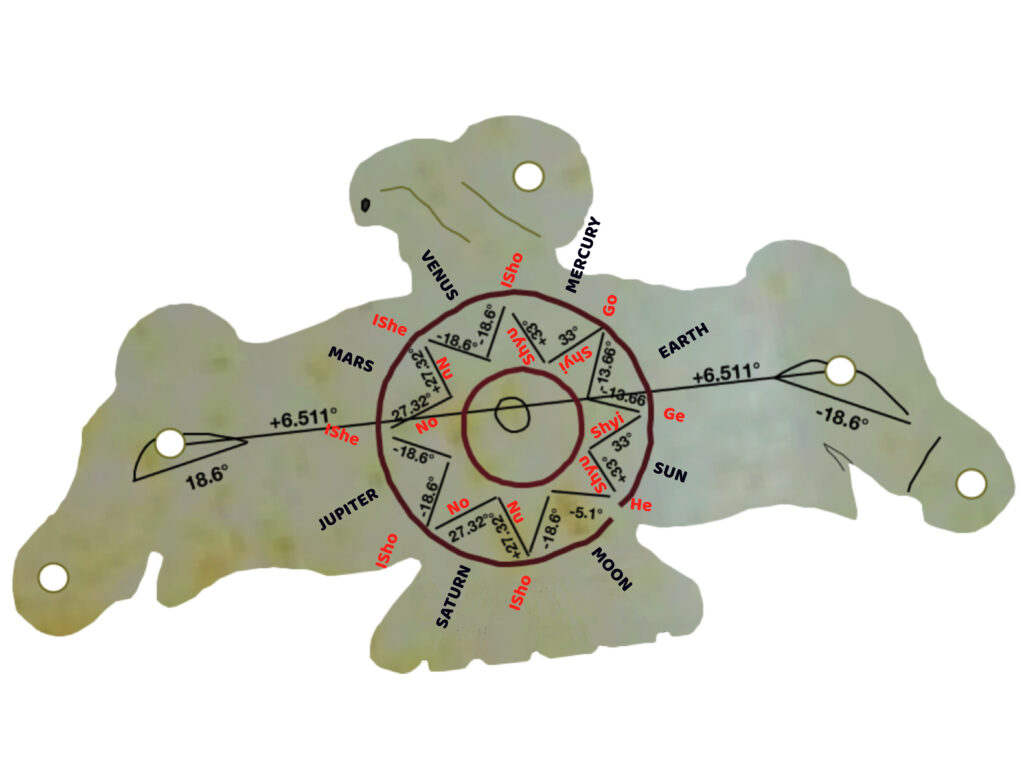
In this current statistical study, the assignment of which phonetic elements are attached to which lines1,2, will not be reviewed here, but the general code can be understood by reviewing the video.
Here, the primary aim is only to determine if the angles present in archaic geometric images repeat, as claimed, in a consistent manner, and whether the same pattern appears in all regions around the world.
An image of one of the static, geometric patterns is shown below. This specific image was taken by the author, and it is from the Temple of Athena in Delphi, Greece, and for the analysis the image can only be rotated by a small amount to account for the camera not being horizontal when the picture was taken or to account for small movements of the Earth due to earthquakes.
As can be seen, after the image of the Temple of Athena is rotated so that the wall is horizontal, and the pillars of the temple are upright, the angles present in the lines formed by the polygonal walls can be compared to a specific set of astronomical values.
In this example some of the lines (these being the lines set to plus and to minus 18.6 degrees, which represents the 18.6 year lunar cycle) are consistent with the proposed theory, and there appear to be the presence of four-fold symmetry in the image, with lines aligned to the same angles at above and below the horizontal and to the left and right of vertical. A similar trend is observed in the lines set to circa 13.66 degrees, which in this model is a value linked to the half-sidereal month. The full duration of the sidereal month is 27.32 days, which appears in one line within this relatively small image.
Other examples of large-scale geometric patterns are the ground lines present at Nazca in Peru, and the layout of the polygonal walls at Saksaywaman Temple, which is also within Peru. As can be seen in the image below, the ability to reconstruct these images using the same limited range of angular values is again apparent. The structure of the oldest lines present in the Nazca lines will be discussed separately in a future paper.

Turning now to portable images, for this experiment, it is important to note that for these smaller, portable images there is often no obvious marker in any of the obtained images that could permit an independent observer to determine what was the original orientation that was used during the construction of the image. In fact, many portable geometrics appear to have been deliberately destroyed after they were made, and all we are left with (in most cases) are small fragments. This problem was noted by Peter Underhill in 201316 who is a researcher in anthropology at Stanford University. This means that, for the images present in this portable group, there is a need for trial and error, to determine a potential orientation, and due to this experimental bias will always occur for data taken from portable items.
So, in order to minimise the effect of bias, the first step was to repeatedly rotate and reanalyse the data, until a best match was obtained.
The bias was then removed by realising that any inherent bias can only affect, at most, the three most common angles measured. This is because, on average, each optimisation only involved looking at, at most, the three most common values.
Thus, if the data from the three most commonly observed angles is removed. Then all remaining angles should be random: that is if the Null Theory is true.
But, if the remaining lines consistently match the data from the fixed orientation sample, then it can be argued that the Null Hypothesis, is incorrect, and the lines must be deliberate, and deliberate intent suggests meaning.
Finally, except where noted in the text, all results have previously been published by the author, and their distributions cannot be changed for the purpose of this experiment1,2.
This acts as a barrier, to prevent any secondary bias from entering the experiment.
The analysis was also limited to images that had previously been published by museums, or those which had previously been published in science journals, or from images where the published data could be reasonably confirmed.
In general, this means the photograph should be taken with the camera perpendicular to the geometric pattern. However, because, in almost all cases, the distance to the image and the type of camera lens used in taking the photographs is not recorded by the archaeologists, thus only the central part of each image can be considered to be reliable.
With respect to the experiment, this issue actually favours the Null Hypothesis, as it introduces a degree of randomness into the observed pattern, which should make it almost impossible to see an overlap between the two datasets if the lines were created with no intent to link the angles to astronomy.
It also needs to noted that there is no claim here that any of these archaic images were constructed to an accuracy of 1/10th, or 1/100th of a degree. That degree of accuracy would be impossible to achieve in ancient geometric images.
The only claim being made here is that is the angles created by these lines can reasonably be reconstructed by a specific, limited range of pre-selected astronomical values.
In terms of accuracy, the best remaining images exhibited an accuracy of ±0.1 degrees in geometric engravings recovered from Stonehenge, while in the poorest quality images the accuracy of some of the shorter, broad lines could reach ±1 degree. Typically when lines were so broad that it was possible to generate lines with error bars exceeding 0.5 degrees these lines were omitted from the study.
For the geometric images considered to be portable the list includes from China, an engraved pattern on a circa 5,500 year old Jade block from Lingjiatan, which is known by Chinese historians as the earliest pictorial Chinese description of Heaven and Earth (this early geometric item, with a known contextual meaning, is from the National Museum of China collection in Gansu; a 5,500 year old Jade “Eagle that is marked by a central geometrical pattern that is considered to be an early representation of the sun17; from the Shuangdun, Bengbu site, four geometric images found on plates 92T0722(28):40; 92T0722(29):51; 91T0819(19):171; and 92T0721(29):3618; two circa 5,000 year old marked axe head fragments from the Liangzhu archaeological site that exhibit linear marks that some have previously argued are consistent with very early Chinese texts19; a geometrical pattern drawn on a Qijia culture Bronze mirror that is dated to circa 4000 year old; the linear early Chinese texts found on Oracle Bone R044284, which was recovered in Pit YH127 from The Ruins of Yin20; and a 14,000 year old marked stone from Pit 1 of the Shuidonggou archaeological site21; from Germany two circa 350,000 year old marked elephant tibia from the Bilzingsleben archaeological site22; from the UK, the lines drawn by the Bush Barrow Gold Lozenge23, the lines present on the Stone of Scone (for this study a detailed image was obtained from Historic Environment Scotland), and the lines found on a statue called the Orkney Venus; from the Czech Republic the circa 30,000 year old Dolní Věstonice wolf bone; from the Meuse Basin in Belgium the Remouchamps bone, which is believed to be between 10,000 to 12,000 years old24; from Patne, in India the linear pattern drawn on an engraved egg9; from Africa a multi-lined star type image drawn by the San Bushmen25; from the Democratic Republic of Congo the circa 20,000 year old Ishango Bone, this bone has marks that the late Alexander Marshack, of the Peabody Museum of Archaeology and Ethnology identified as representing a 6 month calendar; and from South Africa the linear pattern found on two engraved eggs from the Diepkloof Rock Shelter collection26,27; a marked stone recovered from the Wonderwerk Cave, and a marked pebble also recovered from the Wonderwerk Cave10,28; a marked stone from Klein Kliphuis29, a marked stone from Klasies River Cave; and three circa 70,000 to 100,000 year old engraved stones recovered from Blombos Cave, these being identified as Blombos M3-1, M1-5, and M1-6 from the studies undertaken by d’Errico, Henshilwood and Nielsen30-32; and from the Lebombo-Border Cave a marked, circa 43,000 to 44,200 years old Baboon fibula (this was discovered in the 1970s by Peter Beaumont, who later identified the markings as being an early lunar count); and two 24,000 year old Lebombo (Border) Cave notched wooden sticks, which have been identified to be coated with poison31,32. See Cunningham1,2 for the prior studies and the angles present in each of these samples.
The fixed-orientation patterns are; from Peru the Nazca ground lines from all eras of its construction (see Fig. 2), and the angular distribution drawn by the polygonal walls at Sacsayhuamán relative to the cardinal axes (see Fig. 3); from the UK, the angle between neighboring Aubrey Holes, Y Holes, and Z Holes at Stonehenge (see again Cunningham 2012 and 2018); from Greece the angular distribution observed by the various walls within the Acropolis relative to the cardinal directions; and from France the angles present in the geometrical images found at Lascaux Cave, these were recorded by the Musée d’Archéologie Nationale, as part of the ongoing attempt to record and preserve the various Lascaux images.
Also considered to have a fixed-orientation but the images were permitted a small degree of rotation, to account for ground movement, or small potential errors in camera alignment are; from Delphi in Greece the Polygonal wall under the Temple of Apollo, and the polygonal Wall in front of the Sanctuary of Athena33; in Athens a short polygonal wall found at the base of the Temple of Hephaestus in Agora34; in Australia the various geometric patterns found at Carnarvon site, and the geometric images found at the Perminghama Petroglyphs; in America the Anasazi Ridge petroglyphs, and the V-bar-V petroglyphs located in the Sedona Red Rock region; from Tibet a Mascoid with the image supplied from the collection of John Bellezza; from Egypt the linear pattern surrounding an image called the spider, which was found on a wall at the Kharga Oasis; and finally from Hawaii the Olowalu Petroglyphs.
Results & Discussion
In the geometric patterns that are fixed in their orientation (see again Fig. 1 to 3 for examples), five angles dominate. This is shown in Fig 4a. In total 1432 lines were analyzed in the fixed-orientation group. The data for the fixed orientation group is shown directly above the data from the portable “art” group to aid comparison.


click on image to enlarge
As can be seen, the five most common alignments are lines at circa 5 or 5.1 degrees; at 9.3 degrees and 18.6 degrees (which are angles that correspond to the half and full 18.6 year lunar cycle); and at 13.66 and 27.32 degrees, which corresponds to the half and full sidereal month.
In the proposed, Null-Hypothesis (the Null Hypothesis being the current Random Line Hypothesis) it was argued that these five angles should not be highlighted by chance, as the dominant group.
In total 119 lines appear at circa 5.1 degrees (which is equivalent to 8.31% of all lines studied in the fixed-orientation class). this number appears to reflect the five visible planets, but might also reflect the angle of the orbital plane of the moon relative to Earth, and thus it is a number that is very important in predicting when an eclipse might occur.
There are then 106 lines at circa 9.3 degrees, 110 lines at circa 18.6 degrees, 135 lines at circa 13.66 degrees, and 84 lines at 27.32 degrees.
These numbers are between 2.6 times to 4.2 times more frequent than expected for a random array.
Though 878 lines (61.31% of the total) could be considered to be randomly aligned, upon reviewing the data it was found that within this group of 878 lines 685 of these lines were from just one site, the Nazca site, which was by far the largest site studied.
Because the Nazca lines contribute so many lines to the fixed-orientation study, a more detailed analysis of the Nazca lines was undertaken; and from this it was found that not all the lines at Nazca are equivalent. For example, from photographs of the actual lines there are 102 lines that appear to be dashed, and 28 lines that might be original to the site, but appear to now be used as small tourist paths and they are not usually included in the study of Nazca.
Thus it is surprising that within these two lesser studied groups 55 (53.9%) of the dashed lines and 20 (71.4%) of the “path” lines are consistent with the proposed angular theory.
This contrasts with only only 160 of the more prominent, more famous lines matching the proposed theory (this being equal to only 23.4% of the lines in this group).
When compared to the other geometric images from the fixed-orientation group (see Table 1 and 2), the data from the Nazca “famous” lines was found to be an outlier1,2.
The next sample, also with a poor overlap, is the Olowalu Petroglyphs which are found in Hawaii. This only had a 30.51% to the proposed alphabet theory, and Carnarvon came in at 47.06% See Cunningham1,2 for source data; and all other images studies revealed more than 50% of their lines are aligned to these five specific angles.
This seems to suggest the famous Nazca site was constructed in two, or perhaps three distinct stages, with the most prominent pattern (which is the pattern that shows the lowest match to the proposed astronomical-alignment theory) being potentially the most recent stage in the development of the Nazca pattern.
Amongst the other angular values present, the sixth most common angle occurs at circa 1 degree, with 79 lines (or 5.52% of the total) aligned to this angle. This is then followed by four lines that are aligned to circa 11, 23.6, 33, and 40 degrees, which each have between circa 45 to 55 lines. These secondary values, with the exception of the 40-degree line, can all be easily assigned astronomical meanings.
Turning now to the results from hand-portable samples, there were 2106 analyzable lines in this group (see Fig. 4b).
The most obvious result is despite the prior concerns over lens-induced distortions, which had the potential to swing the data in favour of the Null Hypothesis, the same five lines were still found to dominate; with the highest frequencies occurring at circa 5.1, 9.3, 18.6, 13.66 and 27.32 degrees.
Within the study of portable images, there are 464 lines at 5 or 5.1 degrees, 266 lines at circa 9.3 degrees, 198 lines at 18.6 degrees, 277 lines at 13.66 degrees, and 192 lines at circa 27.32 degrees. These numbers are between 4.14 times to 10.02 times more frequent than that expected for a random array.
To begin to compare the two datasets using statistics, the first step was to calculate the number of possible combinations that can arise from 45 isolated peaks (each with a base accuracy of circa ±0.5°); and to then determine the statistical probability that the same pre-selected group of five angles (which were pre-chosen for their astronomical significance) will dominate, in both the fixed-orientation study and the portable-geometric study.
From combination statistics, this is a straightforward calculation, and it can be calculated to be equivalent to a 1 in 1,221,759 chance (from 45C5). This, in probability theory, is equivalent to a p value, of 8.2 x 10⁻⁷, where a p value of .01 represents a 1 percent chance that the lines are random.
A value of 1 indicate 100% certain that the lines are random, and in medical trials a p-value of .05 is the standard used to mark a clinical trial as being successful or statistically significant.
As can be seen the value in this specific test is well below this boundary.
However, this is not the final p value. This is because the 8.2 x 10⁻⁷ p value does not take into account the requirement that the same angles were drawn along four separate directions (that is the lines are offsets to above and below the horizontal and to the left and the right of vertical).
In this case, these four directions can be considered to be four independent datasets. Thus, it is more accurate to say that the probability for these five lines to dominate in the fixed-orientation in all four directions is actually 1 in 2.2 x 1024, which is equivalent to a p value of 4.49 x 10⁻²⁵.
As this p value is already below 6-sigma levels, this value can already be used to argue that that these geometric lines were drawn, intentionally, to these angles, and the lines are not random.
But there is another parameter that must be included. The calculation of the p value must also look at the common overlap that can be seen between the portable-and fixed orientation images. These being the two independent studies that were considered crucial for removing bias from the analysis of the portable “art” images. (see Fig 4a and 4b).


click on image to enlarge
Because the portable sample involved a pre-selection process, which, for the purpose of this statistical study is assumed to have pre-chosen three of the five primary peaks observed (note this is actually a high estimate, because in reality the aligning process usually only employed two of the five peaks), this means, for the portable image study, it is only necessary to calculate the probability that just the last two (out of five) peaks will, by chance, match the proposed five-member series.
This means, in the portable image study, the combination statistics is calculated from 45C2, which is equivalent to a 1 in 990 probability for a single angular range.
In terms of probability this generates a p value of .001, which marks this results alone as being statistically significant, but when this is again modified by the fact the same angles appear in four independent directions, the final probability for this overlap to occur in the portable study in isolation is just 1 in 9.6 x 10¹¹. This equals a p-value of 1.04×10⁻¹², which also equals 6-sigmal levels of certainty.
When the combined p value is calculated for the two independent studies overlapping, the calculated p value is 4.67×10-37, but this is still not the final p value.
This is because, as mentioned earlier, this study is not limited to just five peaks. In this specific study, the interest is in the behaviour of the 16 most common peaks, these being the values considered to be either linked to astronomy, or to geometry, or are seen in above average numbers in prior studies.
As can be seen here, the various peaks do have different numerical frequencies, but what was unexpected is the manner in which they vary, (see Fig. 4a and 4b).
The unexpected result, and this is the first time that this feature has been observed, is the two independent studies show a long, extended series of common increases and decreases, between the various primary and secondary peaks. In total there are four common variations in the five primary peaks and there are ten common increases and decreases between the eleven secondary peaks that were recorded.
The mathematical relationship between the peaks has been discussed in in terms of astronomy, but in terms of phonetics, these common oscillations now appear consistent with standard linguistic theory, which argues some letters (or to be more specific sounds) will appear more often than others.
In terms of statistics, the probability for an identical repetition to occur in sequential magnitudes is just 1 in 1,048,576, this being calculated for 10 common increases and decreases in numerical frequency amongst the secondary angular values; which means, when this probability is combined with the other prior statistical odds, the p-value for these images being random now drops to just 4.45×10-43. If the analysis is extended to include the 5 most common peaks the probability reduces further to just 1 event in 9.2 x 1045, which is equivalent to a p-value of 1.08×10-46.
With the result being at this low magnitude, it was decided it was unnecessary to further refine the data, as it is already reasonable to round this p-value to zero. In statistics this is rare, because a p value of zero implies the proposed alternative theory is proven, which in this case means the lines found in ancient geometric images were created with deliberate intent, and the Null Theory (which argues the lines are random) is disproven
Though this test does not use statistics to test the likelihood that these lines are linked to astronomy (as noted previously, this study only tests the probability that the lines are random), it is clear that there must be an underlying motivation to create lines that repeatedly align to these specific values over such a long period of time in so many different regions.
Because any conceivable motivations that could be based on art are subject to change, people are driven to do new things and follow new fads, this can only argues these archaic lines were considered important in a religious context, and knowledge of time and the motion of the moon does aid in the prediction of Eclipse events.
Concerning the probable meaning behind the other lines; the line at 11 degrees probably equals the 11 day difference between the lunar and solar year and the 33 degree value equals the 33-day reset value that is required to normalise the lunar and solar year each three years, and the line at circa 23.6 degrees is equivalent to the angle of Earth’s axial tilt.
The link to the story of the Tower of Babel is also now unavoidable, as these astronomical images are found worldwide, and their appearance begin early in history, with the three oldest studied geometric patterns being two circa 300,000 years old bones from the Bilzingsleben archaeological site, and one fixed-orientation image, of similar age, that is found on a wall at Rising Star Cave site, in Africa.
The intrigue is the Rising Star Cave is known to have been occupied by Homo naledi, but the same distributions in angular values can also be observed in sites that are linked to anatomically modern Homo sapiens; as well as sites that were occupied by Homo heidelbergensis, and Denisovian hominins.
From this observation it is clear that further work is required to determine who first made these ancient patterns, and to determine if multiple species of human used the this archaic text at the same time.
References
- The Map That Talked, CreateSpace Independent Publishing Platform, first published Nov 2012, current edition published 2018.
- The Babel Texts, CreateSpace Independent Publishing, 2018
- von Petzinger, Genevieve, First Signs: Unlocking the Mysteries of the World’s Oldest Symbols Published. 2017
- Von Petzinger., G., and Nowell, A., A place in time: Situating Chauvet within the long chronology of symbolic behavioral development, Journal of Human Evolution 74:37–54 (2014).
- Bandi, Hans-Georg
- The Art of the Stone Age Forty Thousand Years of Rock Art, H.G. Bandi ed. Introduction, Holle & CO Verlag, Baden-Baden, Germany, 1961.
- Breuil, Henri The Art of the Stone Age Forty Thousand Years of Rock Art. H.G. Bandi ed. Pp 21 Holle & CO Verlag, Baden-Baden, Germany 1961.
- Bednarik, Robert G., Creating Futile Iconographic Meanings. http://www.ifrao.com/creating-futile-iconographic-meanings/.
- Bednarik, Robert G., The Earliest Evidence of Palaeoart, Rock Art Research 2003 20(2):3-28.
- Bednarik, Robert G. and Beaumont, Peter., Pleistocene Engravings from Wonderwerk Cave, South Africa, Préhistoire, art et sociétés: bulletin de la Société Préhistorique de l’Ariège, 2010, Pp 96 ISSN 1954-5045, Nº. 65-66.
- Halverson, J., Art for Art’s Sake in the Paleolithic, Current Anthropology, 1987 Vol 28(1):63-89.
- Halverson, J., The first pictures: perceptual foundations of Paleolithic art, Perceptions 1992 21(3):389–404, (1992).
- Ucko, Peter J. and Rosenfeld, A., Palaeolithic Cave Art, (McGraw-Hill, New York. 1967.
- Researcher Suggests Famous Ancient Inca Monumental Complex Exhibits Astronomical Values, Popular Archaeology, April 2014 https://popular-archaeology.com/article/researcher-suggests-famous-ancient-inca-monumental-complex-exhibits-astronomical-values/.
- Researcher says evidence of astronomical writing etched into Cypriot artefacts, Cyprus Mail https://archive.cyprus-mail.com/2014/02/02/17933/ [accessed 2023].
- Underhill, Peter., 2012 In-person discussions, Stanford University.
- Lingjiatan Culture Research, 凌家滩文化研究, 文物出版社, Lingjiatan Culture Research, Cultural Relics Publishing House 2006 [in Chinese].
- Shuangdun, Bengbu, Neolithic Site at Shuangdun, Bengbu, Kaogu Xuebao 考古学报 (Acta Archaeologica Sinica), 2007, 1, Pp 92-126.
- CBS News release, 2013, https://www.nbcnews.com/sciencemain/5-000-year-old-primitive-writing-generates-debate-china-6c10610754.
- Museum of the Institute of History and Philology, Taiwan (2018). This specific Oracle Bone is currently stored in the Museum of the Institute of History and Philology, Taiwan.
- Personal communications with Shuidongou Site Director Fei Peng, March, 2018.
- Sachsen-Anhalt collection, Image obtained from the Landesamt für Denkmalpflege und Archäologie Sachsen-Anhalt collection, 2018.
- The image of the Bush Barrow Lozenge used in the 2018 study was obtained directly from David Dawson, Director, Wiltshire Museum Collection. It should be noted there are many images online which show reproductions of the Bush Barrow Lozenge, which differ in the angular distribution from the original.
- Demoulin, Alain, the source image used in Cunningham2 was obtained from Landscapes and Landforms of Belgium and Luxembourg, Pp 125, Springer.
- Lewis-Williams, David., The Mind in the Cave: Consciousness and the Origins of Art, 2004.
- Wong, Kate., Engraved Ostrich Eggshell Fragments Reveal 60,000-Year-Old Graphic Design Tradition, Scientific America, Volume 302, Issue 3, March 2 2010: Observations.
- Texier P-J, et al. A Howiesons Poort tradition of engraving ostrich eggshell containers dated to 60,000 years ago at Diepkloof Rock Shelter, South Africa. Proc Natl Acad Sci 107:6180-6185.
- Thackeray, Francis., Personal communication, March 2018. The pebble reported by Peter Beaumont and Robert Bednarik is said to have come from Unit 4, Excavation 1, at Wonderwerk Cave.
- Mackay, Alex; and Welz, Aara., Engraved ochre from a Middle Stone Age context at Klein Kliphuis in the Western Cape of South Africa, Journal of Archaeological Science 35(6):1521-1532, doi 10.1016/j.jas.2007.10.015.
- Henshilwood, Christopher and d’Errico, Francesco, Middle Stone Age Engravings and Their Significance to the Debate on the Emergence of Symbolic Material Culture, Homo Symbolicus: Dawn of Language, Imagination and Spirituality Pp75-96 C. Henshilwood, and F. d’Errico, Eds., John Benjamins, Amsterdam 2011.
- d’Erricoa, Francesco; Banksa William E.; Warrend, Dan L.; Sgubine, Giovanni; Niekerk, Karen van; Henshilwood, Christopher; Daniaue, Anne-Laure; and Goñie, María Fernanda Sánchez; Identifying early modern human ecological niche expansions and associated cultural dynamics in the South African Middle Stone Age, PNAS July 25, 2017(114(30)):7869–7876, doi:pnas.org/cgi/doi/10.1073/pnas.1620752114.
- d’Errico, Francesco; Backwell, Lucinda; Villa, Paola; and Beaumont, Peter B; Early evidence of San material culture represented by organic artifacts from Border Cave, South Africa PNAS July 30, 2012 Vol. 109(33):13214-13219, doi:doi.org/10.1073/pnas.120421310.
- Author image, previously unpublished data.